
According to state officials, the project envisages lifting of 17.40 thousand million cubic feet of water from river Thunga to Bhadra reservoir and 29.90 TMC from Bhadra reservoir.

The Union Budget on Monday evoked contrasting responses in the political arena with the ruling Bharatiya Janata Party hailing it as a vision for an 'Aatmanirbhar Bharat' and the Opposition describing it as a 'let down like never before' that was meant to 'deceive' people.

To threaten China and Pakistan, and then to sharply cut back on military funding, bespeaks a remarkable trust in Beijing and Islamabad that is not borne out by anything they say or do, notes Ajai Shukla.


After a gap of three years, direct tax collections -- which include corporate tax and personal income tax -- have exceeded the Budget estimates for FY'22, indicating economic recovery.
'As the Budget has taken some measures to spur growth, similar action from the MPC may be expected.'

The Ministry of External Affairs (MEA) has been allocated a total of Rs 18,050 crore in the Union Budget for 2023-24 which is an increase of around 4.64 per cent over last year's allocation of Rs 17,250 crore.

While the capital spending is being maintained at 3.1 per cent of the GDP, a little more would have boosted economic growth even further, suggests Rajiv Memani.

Amid FY23 Union Budget's focus on investments, leading domestic credit rating agency Crisil on Wednesday said that the capital expenditure is "not as high as it sounds". It, however, was quick to add that considering that governments usually tend to cut capex during a crisis, the government has maintained its focus on growth-spurring initiatives amid the pandemic. The research wing of the agency said, if one excludes the Rs 1 lakh crore of loans to states for capex included in the headline figure of Rs 7.50 lakh crore or 2.91 per cent, the actual spend in FY23, will go down to 2.58 per cent of GDP, which is barely at par with the revised estimate of FY22.

Master the online ITR filing process and then learn the differences between the old and new tax regimes to pick your best option.

Most of the members, including Prime Minister Narendra Modi, were seen wearing face masks. However, members had crowded the Lok Sabha chamber, while hardly a handful of others, including union ministers Dharmendra Pradhan and Piyush Goyal, were seen seated in the Rajya Sabha chamber.
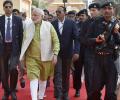
In the Union Budget for 2021-22 presented by Finance Minister Nirmala Sitharaman on Monday, the force received Rs 429.05 crore, an increase of Rs 2.78 crore (or 0.65 per cent hike) from the last budget.

The Congress on Monday strongly criticised the Union budget, saying Finance Minister Nirmala Sitharaman's speech was oblivious to the declining GDP and the budget was a case of "wrong diagnosis and prescription".

'Ek baar aap GST dekh lo!' - Prime Minister Narendra Modi's gentle nudge to Finance Minister Nirmala Sitharaman in December last year sparked the beginning of a mammoth exercise to overhaul the tangled goods and services tax regime. And the final outcome is a significantly simplified system with lower tax rates and easier compliance for businesses.

The introduction of tax deducted at source (TDS) on income from central government securities and state bonds may not lead to a significant effect on retail participation, according to market participants. The Union Budget proposed that starting October 1, 2024, investors may face a 10 per cent TDS on investments in central government securities and state development loans (SDLs). "Last Budget, TDS on interest on securities was reintroduced.

What does this mean for you? Ramalingam Kalirajan explains.

'The new Bill introduces no policy or rate changes, leaving financial planning strategies largely unaffected.'
'The considerations for choosing between the old and new tax regimes remain essentially unchanged.'

The Union Budget has an opportunity to bring into practice the principles of maximum governance, minimum government and ease of doing business by objectively removing anomalies and dated government controls.

The Centre's fiscal deficit at the end of the first seven months of financial year 2024-25 touched 46.5 per cent of the full-year target, government data showed on Friday. In absolute terms, the fiscal deficit -- the gap between government's expenditure and revenue -- was at Rs 7,50,824 crore during April-October period, according to data released by the Controller General of Accounts (CGA). The deficit stood at 45 per cent of the Budget Estimates (BE) in the corresponding period of 2023-24.

Does this Budget deserve cheers or boos? You decide

From the Sensex pack, Mahindra & Mahindra, UltraTech Cement, Power Grid, State Bank of India, ITC, Titan, Tata Motors and ICICI Bank were among the major winners. Tata Consultancy Services, Bajaj Finance, Tech Mahindra, Asian Paints and HDFC were among the major laggards.

Simplifying GST rates, removing exemptions, easing disputes, and speeding up refunds can boost investment in India and offer the best reply to Trump's tariffs, observes V S Krishnan, former member, Central Board of Indirect Taxes and Customs.

From the 30-share blue-chip pack, Bharti Airtel, Power Grid, Bajaj Finance, Nestle, Mahindra & Mahindra, Reliance Industries, Asian Paints, IndusInd Bank, Hindustan Unilever and HDFC Bank were the biggest gainers. Bajaj Finance climbed nearly 2 per cent after the company reported an 18 per cent increase in its consolidated net profit to Rs 4,308 crore for the December quarter.

"The new structure will substantially reduce taxes on the middle class and leave more money in their hands, boosting household consumption, savings and investment," Sitharaman said presenting what was dubbed as 'reformist' budget for the next fiscal in Lok Sabha.

The Parliament resumes on Monday after a break. WATCH THE LIVE DEBATES HERE.

Pre-Budget excercise next month should scrupulously avoid adventurism of all types and refrain from making excessively ambitious projections on revenue and expenditure numbers for 2023-24, suggests A K Bhattacharya.

The government told an all-party meeting Monday that it does not intend to bring any legislative business in Rajya Sabha during the first part of the Budget Session which is till February 11, sources said.

Modi also slammed the "negative politics" of some parties and said they used Parliament's time to hide their failures.

Opposition MPs in India's Rajya Sabha raised concerns about US President Donald Trump's tariff threats, demanding the government clarify its response and engage in discussions with opposition parties. Leaders like P Chidambaram and Sagarika Ghose warned of potential economic repercussions, including depressed exports, lower FDI, and a significant tariff burden. The debate also touched on other issues such as the government's economic policies, demonetization, and the impact of GST on common citizens.

Other ministers who have presented five straight annual financial statements include Arun Jaitley, P Chidambaram, Yashwant Sinha, Manmohan Singh and Morarji Desai.

'That is the one headline the world is reading about India this week, and it is a potentially damaging story...' 'I don't think a panic mentality has set in, but this story is one that investors and market watchers are absolutely seized with.'

Finance Minister Nirmala Sitharaman's Budget speech on Wednesday was marked by the usual thumping of benches by the ruling alliance members, but the loudest cheer was reserved for her announcement of income tax relief, which was welcomed by 'Modi, Modi' chants in Lok Sabha that also witnessed a few instances of protest by the Opposition.

The finance minister's assertion that industry should not expect any spectacular announcements in the 2024 interim Budget suggest that the electoral imperatives of more tax concessions or higher expenditure on welfarist programmes could be far less pronounced than they were before the 2019 interim Budget, expects A K Bhattacharya.

Anticipating US action on tariffs, India seems to have made the first move by revamping its tariff structure by reducing the slabs to eight rates, points out Mukesh Butani.

Top on the government's agenda would be getting Parliament's approval to the budgetary proposals and presentation of the budget for the Union Territory of Jammu and Kashmir.

Week beginning March 12 will unveil, one-by-one, new information and data that will have a bearing on Budget.

Domestic rating agency ICRA on Monday said Indian companies are likely to clock 7-8 per cent revenue growth during the March quarter of the current fiscal year, led by revival in rural demand and uptick in government spending. ICRA expects the private capital expenditure (capex) cycle to remain measured in view of the uncertainties around geopolitical developments and relatively subdued outlook on merchandise exports from India.

The Opposition parties on Friday slammed the Union Budget presented by Finance Minister Pranab Mukherjee as "anti-people", "lacklustre" and one that would increase the financial burden on the common man.

The finance ministry will kick-start the exercise to prepare the Union Budget for financial year 2022-23 (FY23) from October 12, according to an official notification released on Monday. "The pre-Budget meetings as well as the meetings to discuss the revised estimates will start from October 12 and will continue till the second week of November," according to the Budget circular of the Department of Economic Affairs' Budget Division. The Union Budget is expected to be announced on February 1, as has been the practice of the past few years.

The Centre's fiscal deficit at the end of the first five months of the current fiscal touched 27 per cent of the full-year target, government data showed on Monday. In absolute terms, the fiscal deficit -- the gap between expenditure and revenue -- was at Rs 4,35,176 crore as of August-end, according to data released by the Controller General of Accounts (CGA). The deficit stood at 36 per cent of the Budget Estimates (BE) in the corresponding period of 2023-24.
